

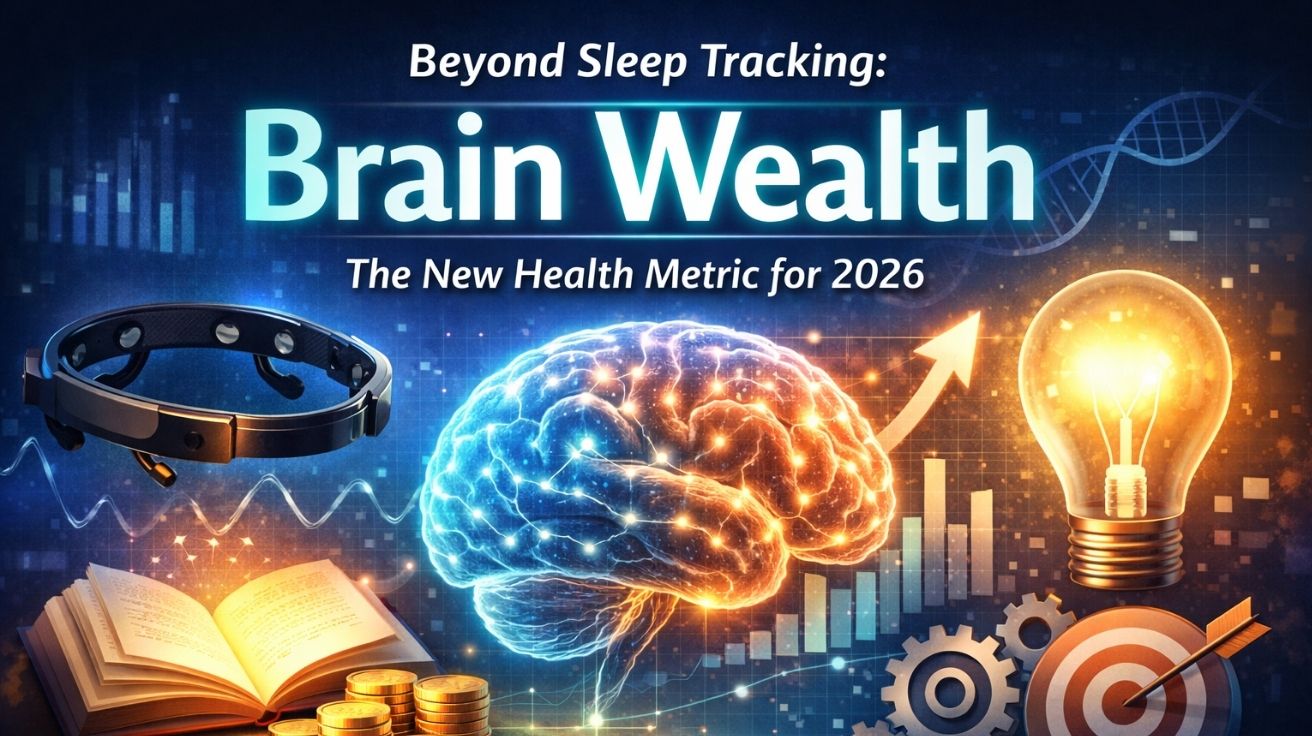
The era of wearable tech obsession is shifting. For the last decade, we have been slaves to the “10,000 steps” rule and the quest for the perfect eight-hour sleep score. We looked at our smartwatches every morning to see a percentage that told us how we felt, rather than actually listening to our bodies. But as we move through 2026, a new term is dominating the wellness space: Brain Wealth. It is no longer enough to just be “well” or “rested”; the goal now is to build a cognitive surplus that allows us to thrive in an increasingly complex digital world.
Building Brain Wealth is about more than avoiding burnout; it is about treating your cognitive reserve like a bank account. Every time you engage in deep work or master a new skill, you are making a deposit. Every time you multitask or ignore mental fatigue, you are making a withdrawal. For students and professionals facing high-pressure deadlines, managing this balance is vital. Many have found that seeking Assignment Help from trusted platforms like myassignmenthelp allows them to protect their mental equity by delegating time-consuming research, ensuring their “brain bank” stays in the black.
The Shift: From Bio-Tracking to Neuro-Equity
In the early 2020s, we focused on physical markers: heart rate, steps, and REM cycles. While these are important, they are “lagging indicators.” They tell you what happened yesterday, not what you are capable of today. Brain Wealth is a “leading indicator.” it measures your Cognitive Reserve—the brain’s ability to improvise and find alternate ways of getting a job done when faced with challenges.
In the UK and across the globe, the conversation on sites like Catimes.co.uk has turned toward Neuro-performance. This isn’t just about being smart; it’s about “Brain Durability.” Can you maintain a high level of critical thinking at 4:00 PM after a day of intense meetings? If the answer is no, your Brain Wealth is low.
The Brain Wealth Comparison Matrix
To understand where you stand, look at how the wellness industry has evolved over the last few years:
| Feature | Old Metric (2020-2024) | New Metric: Brain Wealth (2026) |
| Primary Goal | Physical Longevity | Cognitive Durability |
| Key Tool | Sleep Trackers / Step Counters | Neuro-metric Headbands / EEG |
| Focus | Recovery (Passive) | Optimization (Active) |
| Success Indicator | Low Resting Heart Rate | High BDNF & Neural Plasticity |
| Main Threat | Sedentary Lifestyle | Cognitive Friction & Information Overload |
The Biology of the “Wealthy” Mind
To build a wealthy brain, we have to look at the internal machinery. Two of the most important terms you will hear in 2026 are BDNF (Brain-Derived Neurotrophic Factor) and Neuroplasticity.
Think of BDNF as “Miracle-Gro” for your brain. It is a protein that helps repair brain cells and grow new ones. Neuroplasticity is the brain’s ability to rewire itself based on new experiences. When you have high levels of BDNF, your brain is “liquid”—it can learn faster, adapt to stress better, and recover from mental exhaustion more quickly.
However, the modern world is designed to drain this liquidity. Constant notifications, “tab-switching,” and the pressure of technical precision create Cognitive Friction. This is particularly true for those tackling complex technical subjects like software development or data science. If you are struggling with a difficult coding project, finding expert Programming Assignment Help can give you the breathing room to study the underlying logic rather than getting bogged down in syntax errors. This strategic delegation is a key move for anyone looking to optimize their mental performance.
The Three Pillars of the Brain Wealth Framework
To rank among the “Cognitively Wealthy,” you must focus on three specific areas of investment: Input Quality, Processing Efficiency, and Strategic Offloading.
1. Input Quality: The “Information Diet”
Just as physical wealth requires disciplined saving, Brain Wealth requires disciplined consuming. In 2026, we are seeing a move away from “Algorithm-Led Consumption.” Instead of letting a social media feed decide what you learn, Brain Wealth practitioners use “Curated Input.”
- Deep Reading: Engaging with long-form content (1,200+ words) instead of snippets.
- Semantic Diversity: Learning things outside your primary field to encourage “Cross-Pollination” of ideas.
2. Processing Efficiency: The Flow State
Processing efficiency is about how much energy your brain spends to produce a result. A “poor” brain spends massive energy on distractions. A “wealthy” brain enters Flow—a state where the challenge of the task matches the skill of the individual perfectly.
- Monotasking: The death of the “multitasking” myth.
- Neuro-Nutrients: Using Omega-3s, Lions Mane, and targeted hydration to lower the electrical resistance in neural pathways.
3. Strategic Offloading: The Power of Delegation
The wealthiest people in the world don’t do their own laundry or file their own taxes; they delegate so they can focus on high-value decisions. Brain Wealth works the same way. You should not waste your “Cognitive Gold” on repetitive, low-value formatting or basic data entry.
- Documentation Support: Using professional editors for final drafts.
- Expert Consultation: Using specialized services to bridge knowledge gaps in complex subjects.
The “Information Gain” Strategy for 2026
Google’s 2026 search algorithms have moved beyond keywords. They now look for Information Gain—does this article provide a new perspective or unique data? To rank on the first page, your content must provide “Utility.”
For instance, when discussing Brain Wealth, don’t just say it’s “good.” Explain the Cognitive Load Theory. The human brain can only hold about 7 (plus or minus 2) items in its working memory at once. If 5 of those items are “worrying about a deadline,” “fixing a typo,” or “searching for a citation,” you only have 2 items left for actual brilliance. By offloading the “friction” tasks, you clear the working memory for “Wealth-Building” thoughts.
The Rise of “Slow-Tech” in the UK
In London and Manchester, a new trend called “Slow-Tech” is emerging. It involves using devices with E-ink screens (like tablets that only allow writing) to reduce dopamine spikes. This is a direct response to the Brain Wealth movement. People are realizing that the “constant buzz” of a smartphone is a tax on their mental equity.
By adopting Slow-Tech, individuals are essentially “refinancing” their brain’s debt. They are moving away from the high-interest stress of social media and into the low-interest, long-term growth of deep focus. This is why we see high-performing students and researchers prioritizing “Deep Work Blocks” where they go offline for 4 hours a day to produce their most important assignments.
Frequently Asked Questions (FAQ)
What is the fastest way to increase my Brain Wealth score?
The fastest way is to eliminate “Micro-Distractions.” Turn off all non-human notifications on your phone. This immediately stops the “Attention Drain” and allows your brain to start recovering its baseline focus.
How does “Assignment Help” relate to brain health?
It is a tool for Cognitive Load Management. By delegating the structural and research-heavy parts of a project to experts, you preserve your mental energy for the “Executive Functions”—the high-level thinking that actually earns you grades and promotions.
Are there specific foods that act as “deposits” for Brain Wealth?
Yes. High-quality fats (Avocados, Walnuts), Leafy Greens (Vitamin K), and Berries (Flavonoids) have been shown to improve the speed of neural communication and protect against cognitive decline.
Can I measure my Brain Wealth at home?
While professional EEG scans are best, you can track your “Focus Duration.” How many minutes can you work on a single task without feeling the urge to check your phone? If it’s under 20 minutes, your Brain Wealth needs investment.
Conclusion: The Future belongs to the Focused
As we look toward the future, the divide between those who can focus and those who cannot will become the new “Wealth Gap.” Brain Wealth is the ultimate currency of 2026. It determines how we work, how we learn, and ultimately, how we feel about our place in the world.
Whether you are a student navigating a difficult degree, an engineer tackling a programming challenge, or a writer crafting a guest post for Catimes.co.uk, remember: your focus is your fortune. Don’t spend it on trivialities. Use the tools at your disposal—from neuro-metrics to professional support services—to keep your brain’s “bank account” full. In the high-speed world of 2026, the most successful people aren’t the ones who work the most hours; they are the ones who have the most “Wealth” between their ears.
Do Read: Quitting Smoking Stages – Complete Timeline, Symptoms, and Recovery Guide